Description
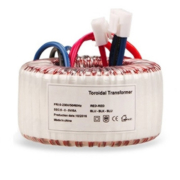
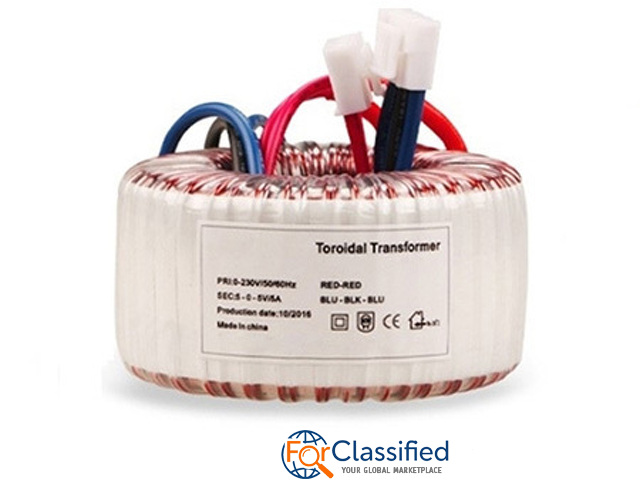
Toroidal transformers are a type of transformer characterized by their ring-shaped, or doughnut-like, magnetic core, around which the winding is evenly distributed. This distinctive design allows the magnetic flux to circulate within the core in a closed loop, significantly reducing leakage flux and improving overall efficiency. As noted on steptransformer.com, toroidal transformers are known for their compact structure and high performance, offering advantages over traditional laminated core transformers in many applications.
The operating principle of a toroidal transformer is based on electromagnetic induction, similar to other transformer types. When alternating current flows through the primary winding, it generates a magnetic field within the toroidal core, which then induces a voltage in the secondary winding. Because the windings are uniformly wrapped around the entire core, the magnetic field is well-contained, resulting in minimal energy loss and low electromagnetic interference.
One of the key benefits of toroidal transformers is their high efficiency and reduced core losses. The continuous grain-oriented core structure allows for better magnetic properties, leading to lower hysteresis and eddy current losses. This efficient operation also contributes to reduced heat generation, enabling smaller size and lighter weight compared to conventional transformers of similar power ratings. In addition, the symmetrical design helps minimize mechanical vibration, resulting in quieter operation.
Toroidal transformers are also valued for their low stray magnetic field. Since the magnetic flux is largely confined within the core, they produce less external interference, making them ideal for use in sensitive electronic equipment such as audio systems, medical devices, and precision instruments. Their compact form factor further supports applications where space is limited and high power density is required.
Despite their advantages, toroidal transformers can be more complex and costly to manufacture due to the difficulty of winding coils evenly around the core. They may also have higher inrush current during startup, which requires careful circuit design to manage. Nevertheless, their superior efficiency, low noise, and compact size make them a preferred choice in many modern electrical and electronic systems where performance and reliability are essential.




 Loading